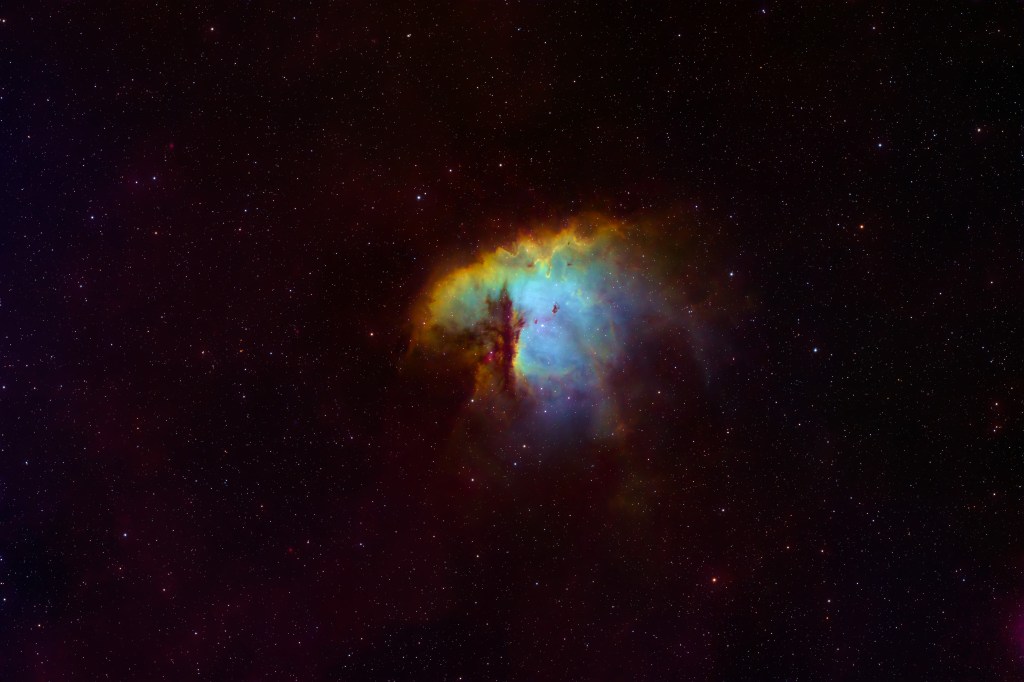
The Pacman Nebula is an emission nebula in the constellation Cassiopeia. Discovered by Edward Barnard in 1883, it lies about 9,200 light-years from Earth and spans approximately 80 light-years. This region of star formation is of particular scientific interest because its large stars are relatively unobscured by dust. Such stars contribute substantial energy to the galaxy, but dust often obscures them elsewhere; their visibility here makes this region especially interesting to study.
Data Collection and Processing
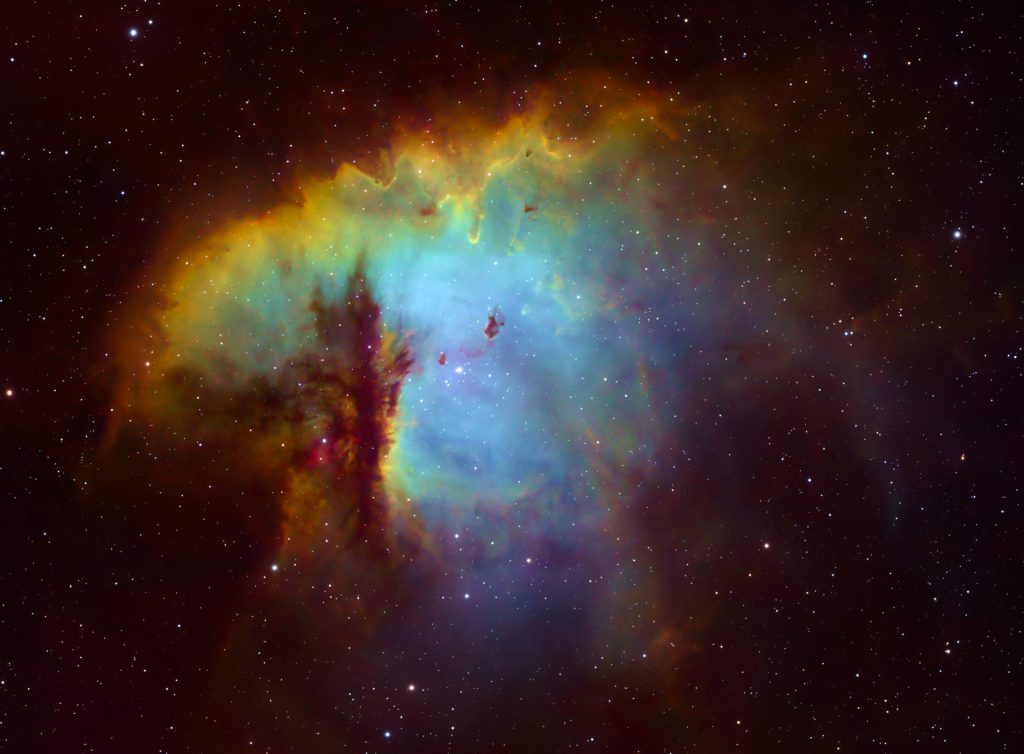
I captured this object over two nights using two different narrowband filters, then adjusted my typical workflow to process the resulting datasets separately before combining them. First, I stacked the datasets in WBPP and applied MultiScale Gradient Correction and Blur-Xterminator to both stacked images. Before extracting the narrowband channels, I used Star-Xterminator to create a separate stars image from the Ha/OIII image and saved it for later recombination. Next, I used the SetiAstro NB Extract Tool to extract Ha and OIII from the first image and SII from the second. I removed the stars from all three extracted narrowband channels with Star-Xterminator, then combined the starless channels using LRGB combination. I stretched the combined image with MultiScale Adaptive Stretch, sharpened it with MultiScale Median transformation, and applied Noise-Xterminator. I then performed background neutralization and color channel alignment before adjusting saturation and other levels with curves. Finally, I stretched the saved stars image with the SetiAstro NB to RGB stars script and recombined it with the processed starless image using Pixelmath. I’m pleased with the final result.
Technical Card
Mount: Celestron AVX
Camera(s): ZWO ASI 2600mc pro; ZWO ASI 120 mini guide camera
OTA: ZWO FF80
Guidescope: Williams Optics 50mm guidescope
Filters: Optolong L-Nhance, Aksar Colour Magic C2
Exposure: 140 Lights @ 300 seconds
Alternate Image
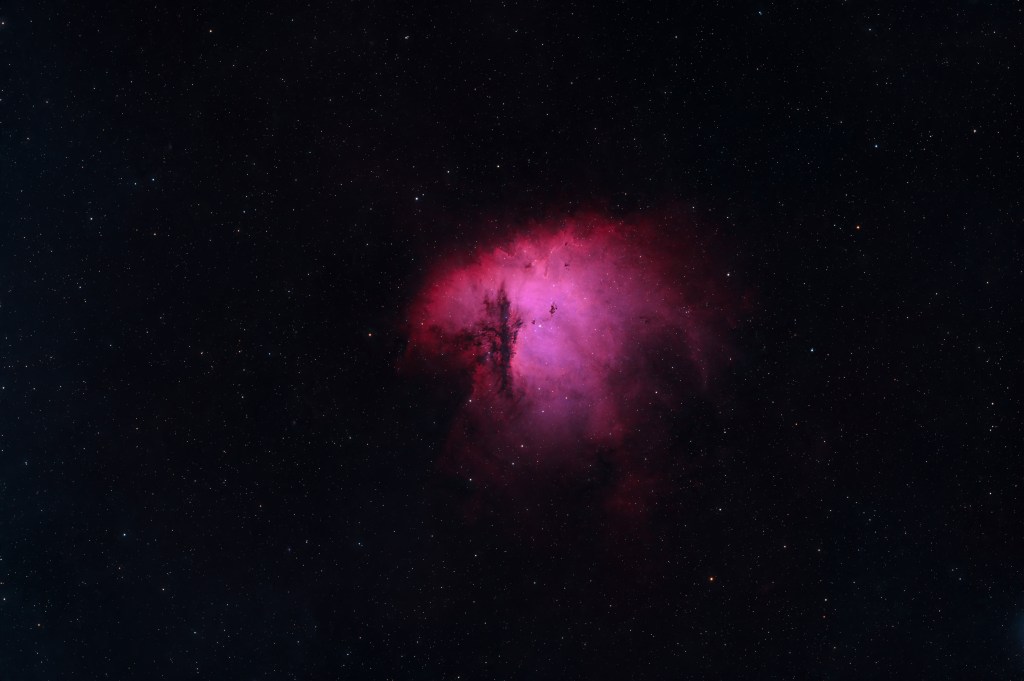
For an alternative view, I processed the Ha/OIII data separately in an HOO palette rather than combining it with the SII channel. I find this version interesting as a different treatment of the same object.


Leave a Reply