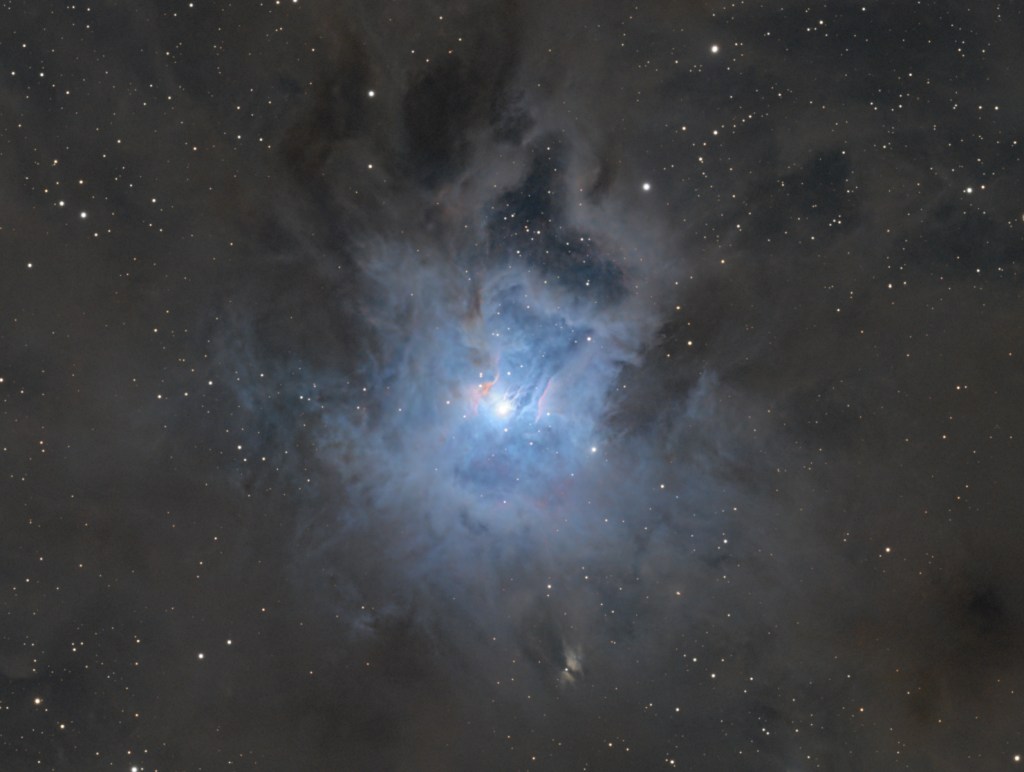
The Iris Nebula is a reflection nebula located in the Constellation of Cepheus. A reflection nebula is a cloud of gas and dust that is illuminated or excited by a nearby stars. It was first discovered by William Herschel in 1794. It is located approximately 1400 lightyears away from earth. It is approximately 6 lightyears across, with an apparent size of 18 arcminutes.
This nebula is illuminated by its central star, designated HD 200775, and appears with primarily a blue color. However, it also reflects filaments of deep red, indicating the presence of complex hydrocarbons. The composition of the gas cloud is an area of active research, and in 2010 observations from the Spitzer Space Telescope were used to confirm the presence of fullerenes excited by UV radiation. This was one on the largest confirmed molecules confirmed to exist in interstellar space. Additionally, while fullerenes were known to be capable of forming in supernova, the location and concentration in NGC 7023 suggested that additional formation mechanisms exist to allow formation in cold interstellar gas.
Data Collection and Processing
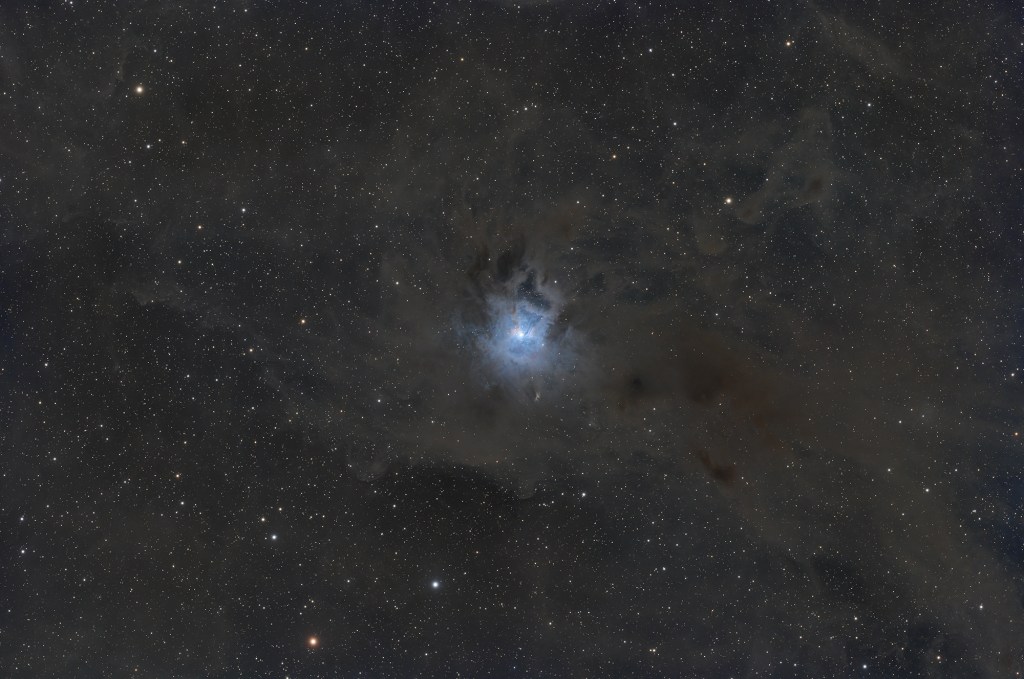
My goal with this photograph was to capture the rich colors both within the illuminated portions of the nebula and contrast it with the dark clouds surrounding it. The bright region showed well after the first night of capture, but I elected to gather data for two additional nights to bring out the dark regions.
To process the data I used PixInsight, applying gradient removal with the Multi-scale Gradient Removal, using BlurX and NoiseX for deconvolution and noise reduction. I then stretched the background with the Multi-scale Adaptive Stretch tool, separately stretched the stars with the Histogram tool, and recombined the image with Pixelmath.
Technical Card
Mount: Celestron AVX
Camera(s): ZWO ASI 2600mc pro, ZWO ASI 120 mini guide camera in a Williams Optics 50mm Uniguide
OTA: ZWO FF80 APO
Filters: None
Exposure: Approximately 300 Lights @ 180 seconds taking in June and July over 3 nights
References:
Note:
This post was submitted as an article to the Journal of the NJAA
 Sweetman Astrophotography
Leave a comment