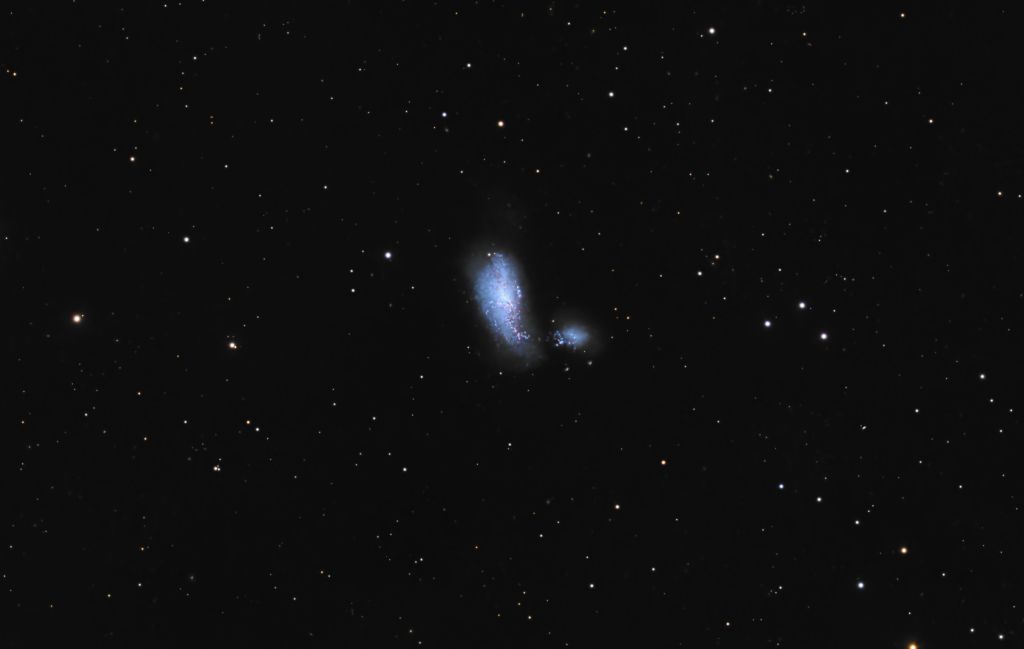
Note: I chose this photo to write up for my astronomy club’s astronomy journal, so the write up is a little longer than my typical.
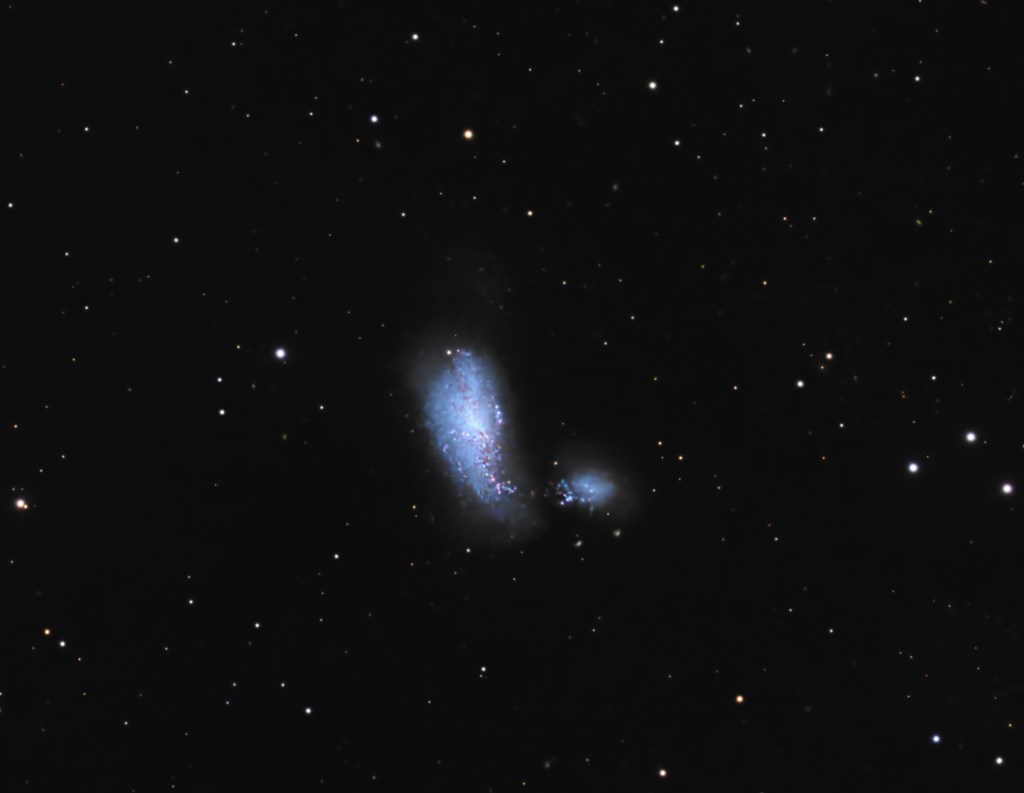
March through May is often referred to as ‘galaxy season’ among amateur astronomers. During this period, the night sky is oriented away from the Milky Way’s central plane, improving visual access to extragalactic space. This galaxy season I decided to focus on photographing interacting galaxy groups, here is one of the ones I chose; NGC 4490 along with NGC 4485; also catalogued in the Atlas of Peculiar Galaxies as Arp 269
Aquisition
I photographed this on the night of 3-4 May 2026. The conditions were less than ideal, as the moon was 93% illuminated and it rose at 23:22. As a result of the bright moon, I was not able to resolve stars suitable for at my preferred guiding integration period of 0.5 seconds; I had to increase to 2 seconds which did cause some additional spread of the stars beyond the atmospheric dispersion limit. Additionally, there were some occasional light clouds which caused several periods of complete guidance failure. Despite all that, better than 80% of my frames overall were of acceptable quality, and I was able to create a clean image.
Processing
I gathered 130 images at 180 seconds each, and these were stacked in PixInsight along with 25 flat images, 20 dark frames, and 100 bias frames. I used GraXpert to extract the gradient, performed a SpectoPhotometric Color Calibration, deconvolution with Blur-Xterminator and noise removal with Noise-Xterminator. I then removed the stars with Star-Xterminator, and stretched the image with the MultiScale Adaptive Stretch tool. I performed some sharpening with MultiScale Median Tranformation, some minor adjustments with the Curves tool, and then I stretched and added back the stars to complete the image.
Scientific Context & Recent Findings
NGC 4490 is a barred spiral galaxy in the constellation Canes Venatici. As with many other galaxies, it was discovered by William Herschel in 1788. NGC 4490 and NGC 4485 form an interacting pair of dwarf Galaxies approximately 25 million light-years from earth. This is one of the closest pairs of interacting dwarf galaxies, which provides a unique opportunity for study of an interacting dwarf pair. Dwarf galaxies are of particular interest because it is believed that these galaxies are most similar to the galaxies of the early universe, and these galaxies are the subject of several recent studies.
In a 2020 paper, based on data from the Spitzer Space Telescope it was revealed that this galaxy has two cores, one in the visible wavelengths and another visible only in radio wavelengths. These two cores are similar to other dual core interacting galaxies, making it likely that NGC 4490 is itself the product of a merger of two smaller galaxies.
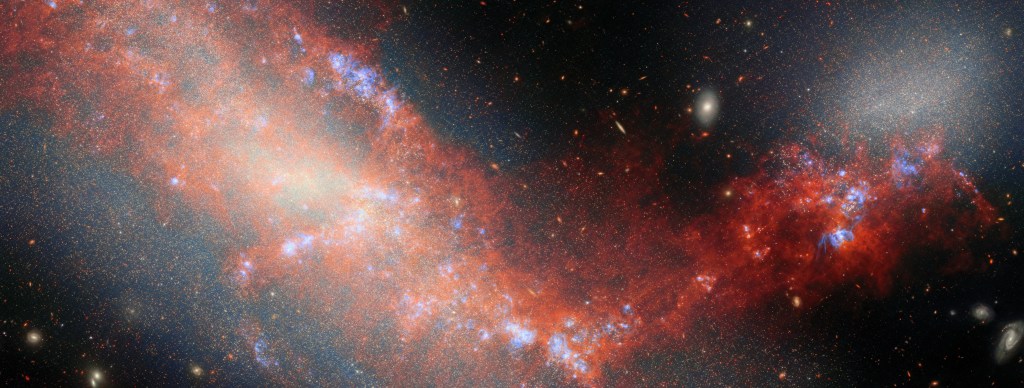
In 2025, a study was published based on data from the James Webb Space Telescope. It had long been known that the two galaxies were connected by a stream of H I gas, but this had not been effectively studied yet. The JWST collected data in the Near IR and Mid IR, and this was combined with a visible light image from Hubble to create a stunningly detailed image of the connecting region. What this data was able to establish is that there were two recent periods of intense star formation, approximately 200M and 30M years ago. The earlier period likely is the product of the cores passing by each other, dragging a trail of gas between them. This trail of gas then mixed and caused the second, more recent period of star formation.
Technical Card
Mount: Celestron AVX
Camera(s): ZWO ASI 2600mc pro, ZWO ASI 220 mini guide camera on an OAG
OTA: Celestron C8 SCT with 6.3 reducer
Filters: None
Exposure: 130 Lights @ 180 seconds
 Sweetman Astrophotography
Leave a comment