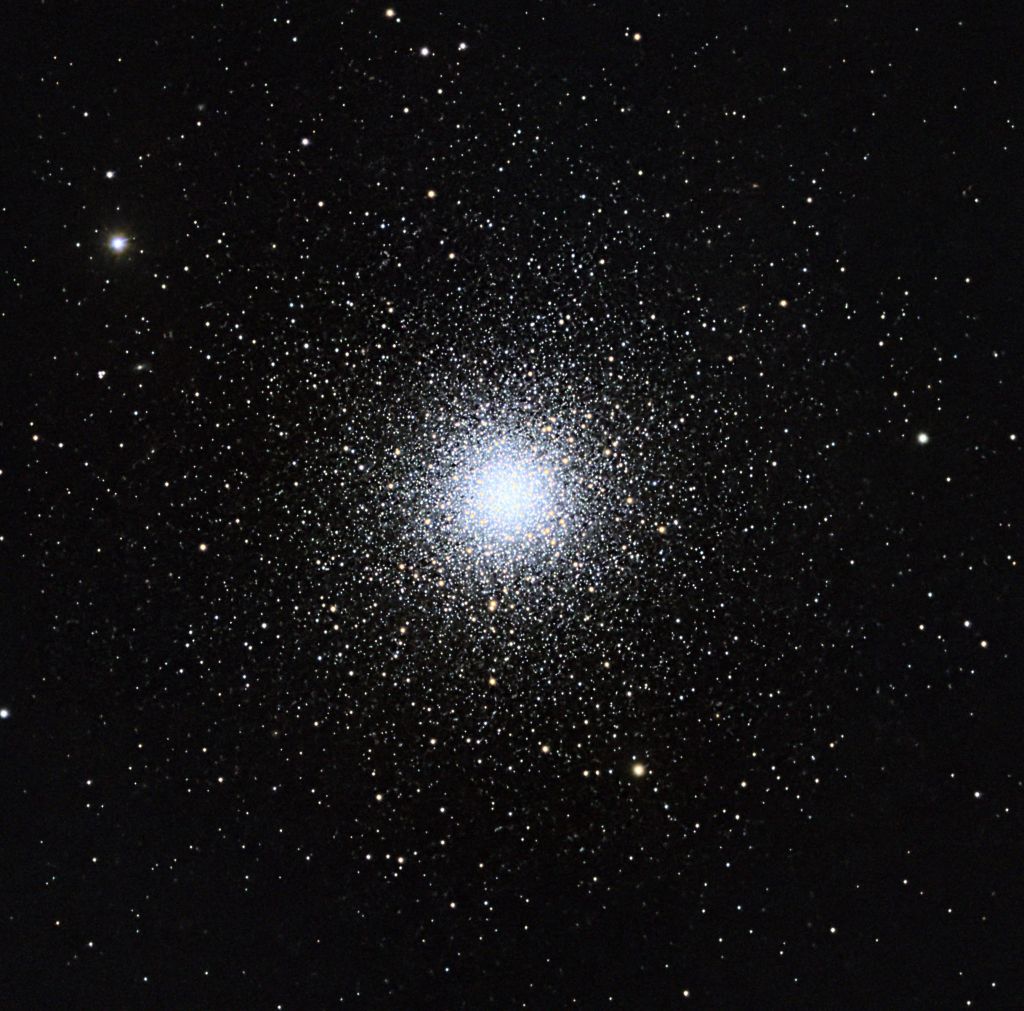
M3 is the first object in the Messier list to have been discovered by Charles Messier himself on 3 May 1764. Messier mistook it for a starless nebula, and it was William Herschel who correctly identified it as containing stars in 1784.
M3, also catalogued as NGC 5272, is a large, bright globular cluster in constellation Canes Venatici, about 34,000 light-years away. It contains roughly 500,000 stars packed into a dense, spherical halo about 180 light-years across. The bright core is approximately 6 light years across.
It is one of the older structures in the Milky Way at around 11 billion years old. It is composed primarily of metal-poor stars formed early in the history of the universe. The cluster also hosts red giants, horizontal branch stars, and blue stragglers, highlighting ongoing stellar interactions within its dense core. Its location high above the galactic plane keeps it relatively isolated and provides a clean for study.
It also stands out for its unusually rich population of variable stars, with over 270 identified, including many RR Lyrae. This makes it a key reference object for the “cosmic distance ladder” which helps us measure the distance to distant galaxies.
Data Collection and Processing
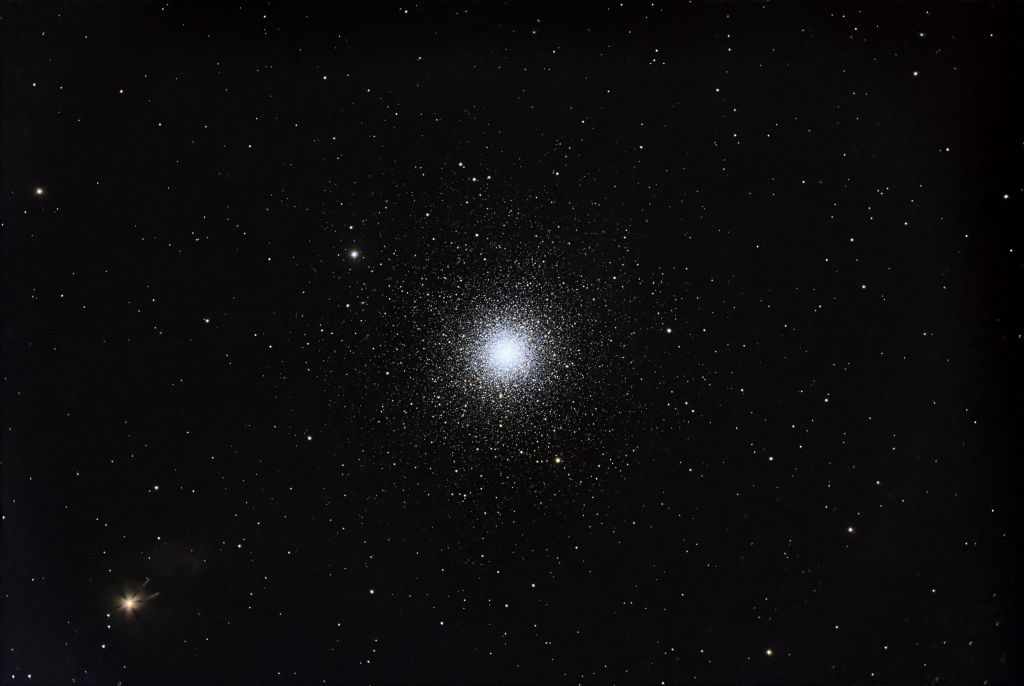
This is my second attempt a imaging a globular cluster, and my first with a cooled astronomy camera. I wanted to resolve star details as close as possible to the core, as well as preserve the color information. In my first attempt, I exposed for around 90 seconds, which upon seeing the results was clearly too long. I decided to go for around an hour of total integration time, with 30 second subframes. I think this worked quite well, although it probably wouldn’t have hurt to go a little shorter.
For processing this image was drizzled at 1x, and then I used a workflow consisting of Graxpert, Blur-X, Noise-X, and Star-X. The reason I removed the stars is because the bright star in the lower left caused an artifact that I removed with the Seti-Astro Blemish Blaster tool. I then replaced the stars with Pixelmath and stretched with the multi-scale adaptive stretch and sharpened with multiscale median transformation.
Technical Card
Mount: Celestron AVX
Camera(s): ZWO ASI 2600mc pro, ZWO ASI 220 mini guide camera on an OAG
OTA: Celestron C8 SCT with 6.3 reducer
Filters: None
Exposure: 67Lights @ 30 seconds
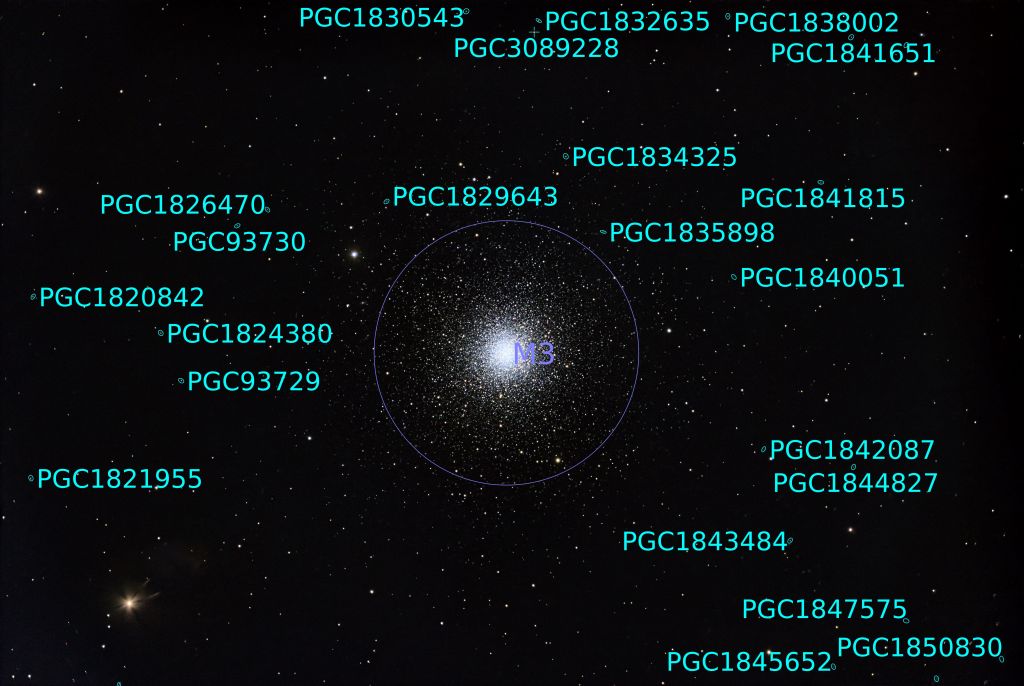
Annotated image:
 Sweetman Astrophotography
Leave a comment