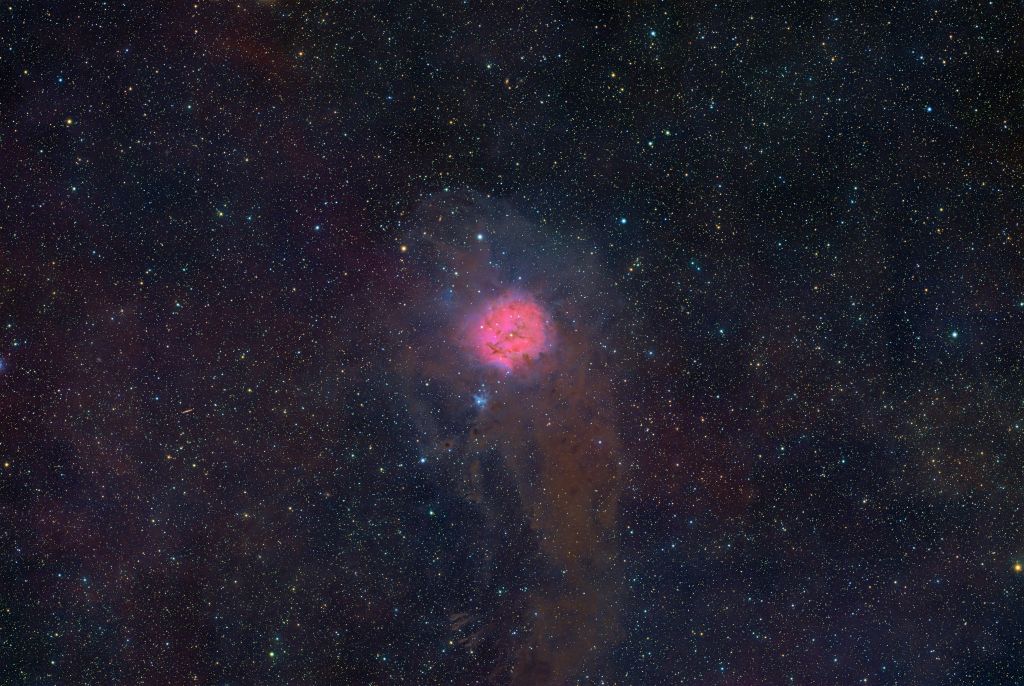
The Cocoon Nebula, IC 5146, is a compact mixed emission and reflection nebula in Cygnus, also catalogued as Caldwell 19 and Sh 2-125. Located roughly 2,500 light-years away, it sits in a rich Milky Way star field.
This region is an active stellar nursery, young stars illuminate the surrounding gas, while dark lanes of dust, including Barnard 168, frame the glowing core and give the nebula its cocoon-like appearance. The contrast between red hydrogen emission, blue reflection nebulosity, and the surrounding dark dust makes IC 5146 an interesting and popular target for wide-field astrophotography.
Technical Card
Mount: Celestron AVX
Camera(s): ZWO ASI 2600mc pro; ZWO ASI 120 mini guide camera
OTA: ZWO FF80
Guidescope: Williams Optics 50mm guidescope
Filters: None
Exposure: 270 Lights @ 180 seconds, 60 Lights at 30 seconds
Capture and Processing
I had originally tried capturing this nebula with a dual narrowband filter(Ha/OIII). However, after stacking the first night I realized that the dark and reflection parts of the nebula were rejected by the narrowband filter. This target is much better suited for broadband photography. So I tried the capture a second time with the goal of capturing the bright and the dark areas. Ultimately, I ended up with two nights of broadband data.
I saw that this target has a rich star field, so I made the decision to capture the stars with 30 second shots, to avoid losing the color detail in the stars to saturation. Pixinsight automatically stacks the different exposure lengths to commonly registered masters, so combining the sets is easy. I applied SPCC, and a common crop to both masters, then extracted the stars from the 30 second master to use as my stars image. I then proceeded with my now standard workflow, with gradient extraction, BlurX, Multi-scale stretch, Multi-scale median transform, NoiseX, Curves, and PixelMath for recombination.
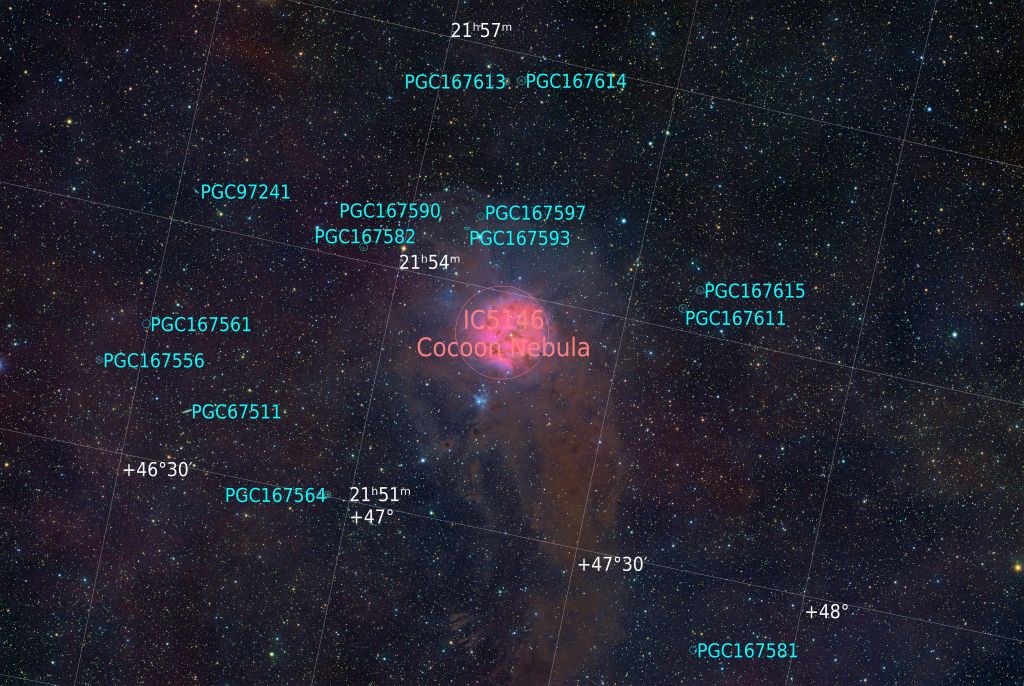
Annotated image
There are a number of smaller and very distant galaxies that can be seen through the dust, and they are highlighted here.
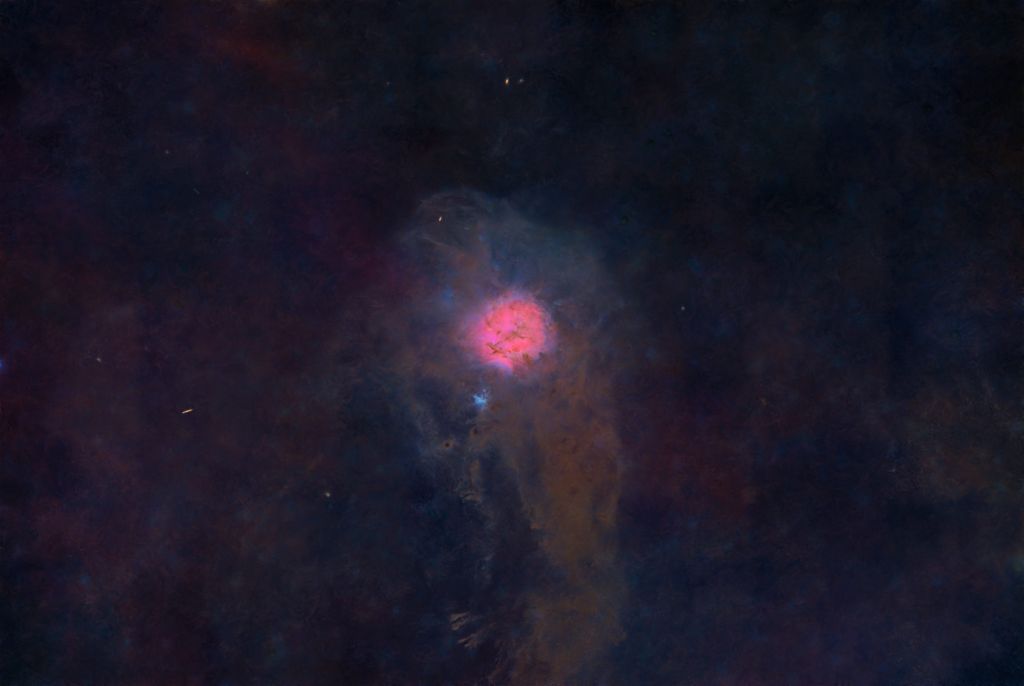
I’ll also add the starless image to be able to see some of the fainter elements of the nebula region.
References and sources
- Constellation Guide — Cocoon Nebula
- Sky & Telescope — IC 5146 Cocoon Nebula and Barnard 168
- Deep Sky Corner — Cocoon Nebula (IC 5146)
- AstroBackyard — The Cocoon Nebula in Cygnus

