
Shown above is my second attempt at imaging M13, the Great Hercules Cluster. I decided to revisit it because both my skills and equipment have improved significantly since my first attempt, and I knew there was far more detail waiting in the data than I was able to capture the first time around.
M13, The Great Hercules Cluster was discovered by Edmond Halley in 1714, and catalogued by Charles Messier in 1764. It would be another 15 years before individual stars would be resolved in 1779.
M13 (NGC 6205) is a large, bright globular cluster in constellation Hercules, about 25,000 light-years away. It is resolvable with binoculars, and can be naked eye visible in good seeing under dark conditions. It contains an estimated 300,000 to 500,000 stars packed into a dense, spherical halo about 145 light-years across.
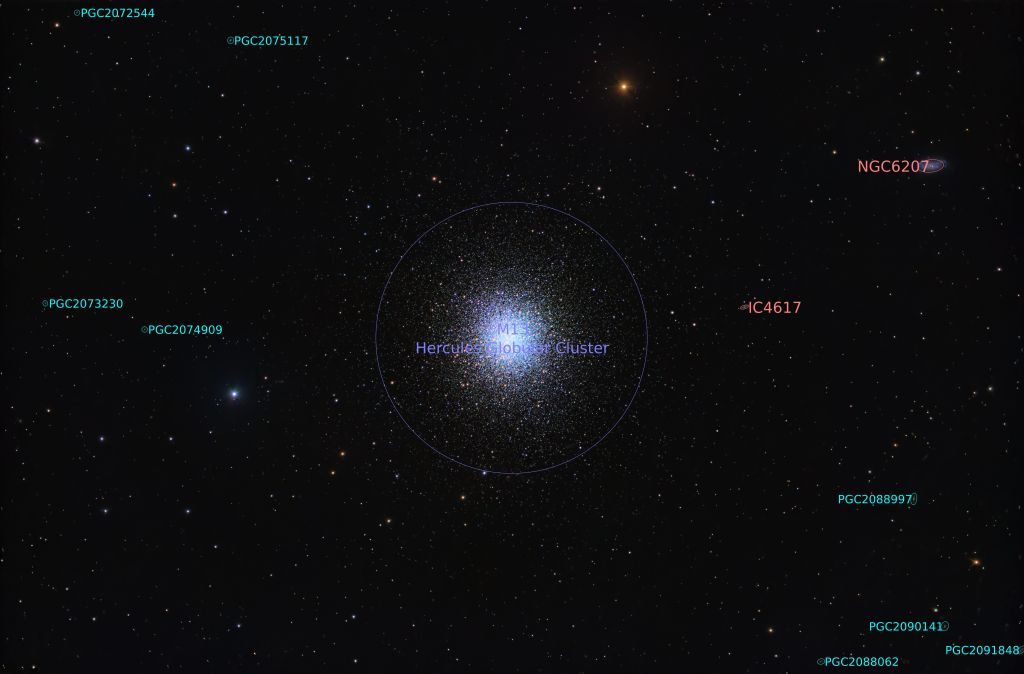
Also easily visible in this image are two unrelated galaxies, IC 4617 and NGC 6207. IC 4617 was discovered by American astronomer E. E. Barnard, but the date of discovery is not known. Like so many other galaxies, NGC 4617 was discovered by William Herschel on 16 May 1787.
Data Collection and Processing
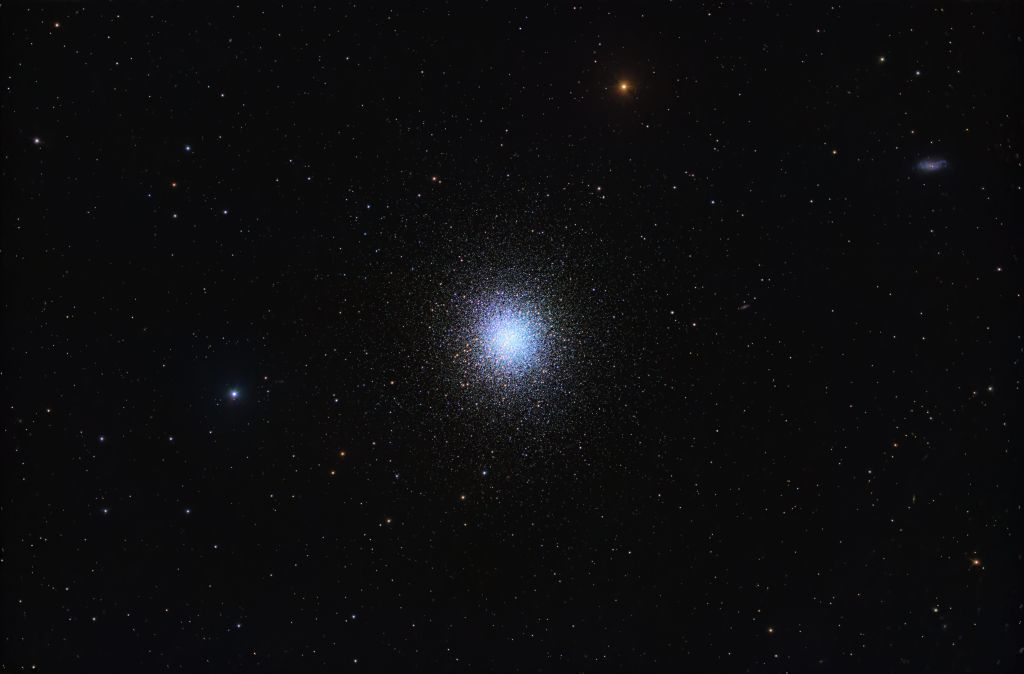
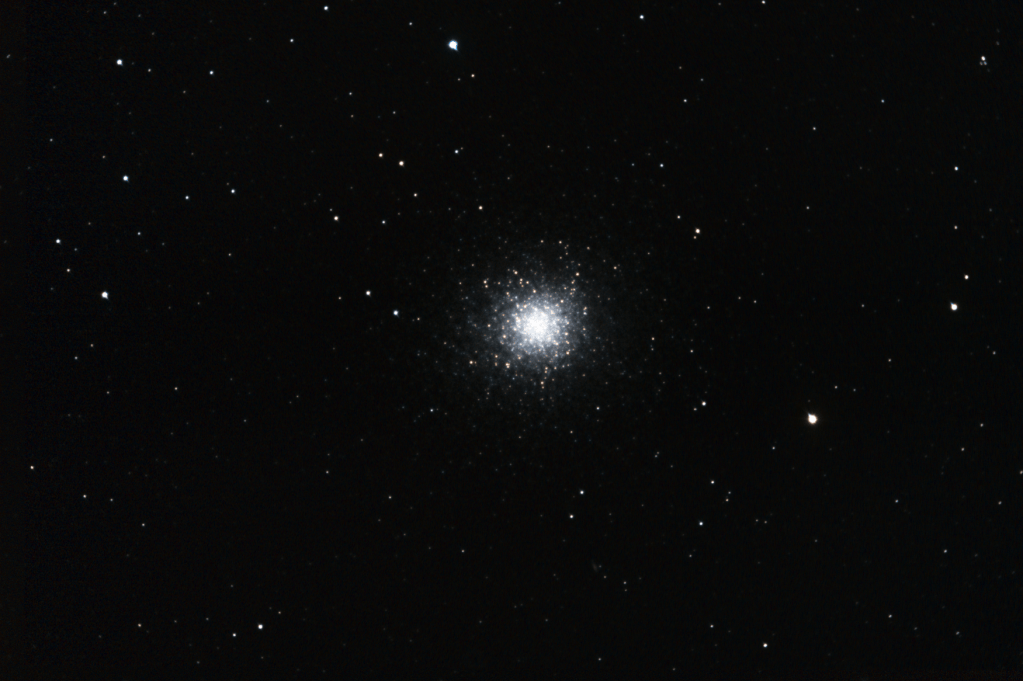
This is my second attempt imaging this object and my first with a cooled astronomy camera. I went with shorter exposures, combined with better processing technique, and the better camera made a significant difference in photo quality. My first attempt is shown below.
For processing this current image, I drizzled at 1x, and then I used a workflow consisting of Graxpert, Blur-X, and Noise-X. I stretched with the multi-scale adaptive stretch and sharpened with multiscale median transformation. As with the my previous attempt at a globular cluster, I stretched with the stars, since the image consists mostly of stars. I did make generous use of the Dynamic Range Compression setting to control the core and the stars while pulling out the background galaxies.
Technical Card
Mount: Celestron AVX
Camera(s): ZWO ASI 2600mc pro, ZWO ASI 220 mini guide camera on an OAG
OTA: Celestron C8 SCT with 6.3 reducer
Filters: None
Exposure: 79 Lights @ 30 seconds
Annotated image:
Previous Image:
Mount: Celestron AVX
Camera(s): Canon Rebel T2i
OTA: Celestron C8 SCT with 6.3 reducer
Filters: None
Exposure: 79 Lights @ 120 seconds
 Sweetman Astrophotography
Leave a comment