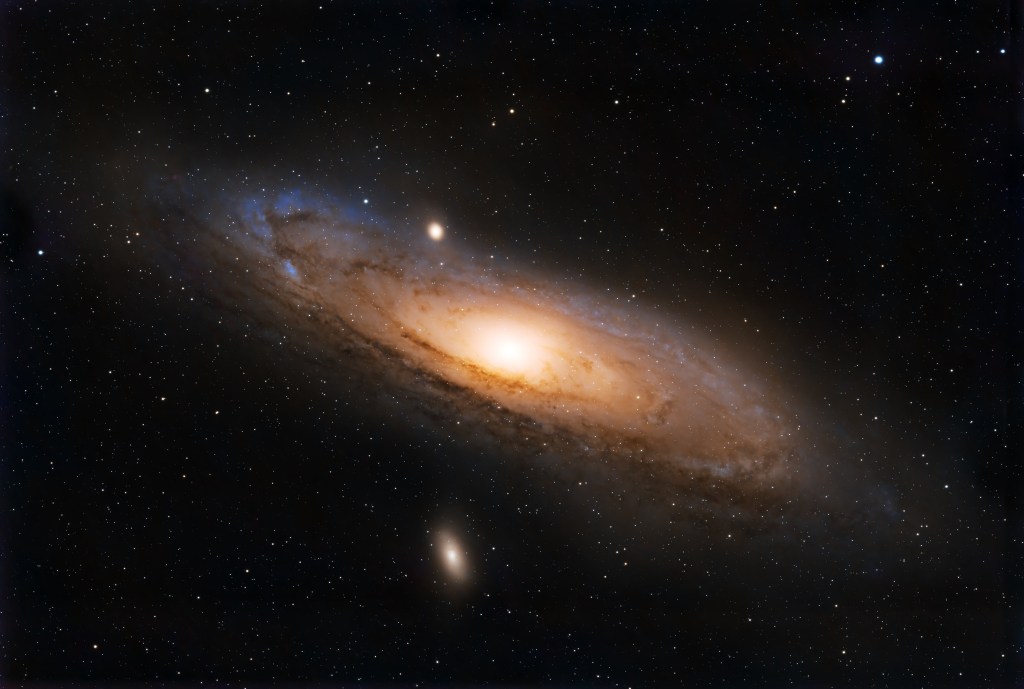
From Wikipedia: The Andromeda Galaxy is a barred spiral galaxy, and it was originally named the Andromeda Nebula and is cataloged as Messier 31, M31, and NGC 224. The Andromeda Galaxy has a diameter of about 46.56 kpc (152,000 ly), making it the largest member of the Local Group of galaxies in terms of extension. The Milky Way and Andromeda galaxies are expected to collide with each other in around 4–5 billion years, merging to potentially form a giant elliptical galaxy.
The Andromeda Galaxy is visible to the naked eye in dark skies. Around the year 964 CE, the Persian astronomer Abd al-Rahman al-Sufi described the Andromeda Galaxy in his Book of Fixed Stars as a “nebulous smear” or “small cloud”.
In 1920, the Great Debate between Harlow Shapley and Curtis took place concerning the nature of the Milky Way, spiral nebulae, and the dimensions of the universe. To support his claim that the Great Andromeda Nebula is, in fact, an external galaxy, Curtis also noted the appearance of dark lanes within Andromeda that resembled the dust clouds in our own galaxy, as well as historical observations of the Andromeda Galaxy’s significant Doppler shift. Edwin Hubble settled the debate in 1925 when he identified extragalactic Cepheid variable stars for the first time on astronomical photos of Andromeda.
Processing
Processing was with PixInsight utilizing the RC Astro plugins. I leaned heavily on Lukmatico’s excellent tutorial for galaxy processing.
Technical Card
Mount: Celestron AVX
Camera(s): ZWO ASI 294mc pro, ZWO ASI 120 mini guide camera
OTA: Apertura 60mm FPL-53 doublet with flattener
Filters: Baader UVIR/Cut
Exposure: 507 Lights @ 120 seconds
Followup Capture
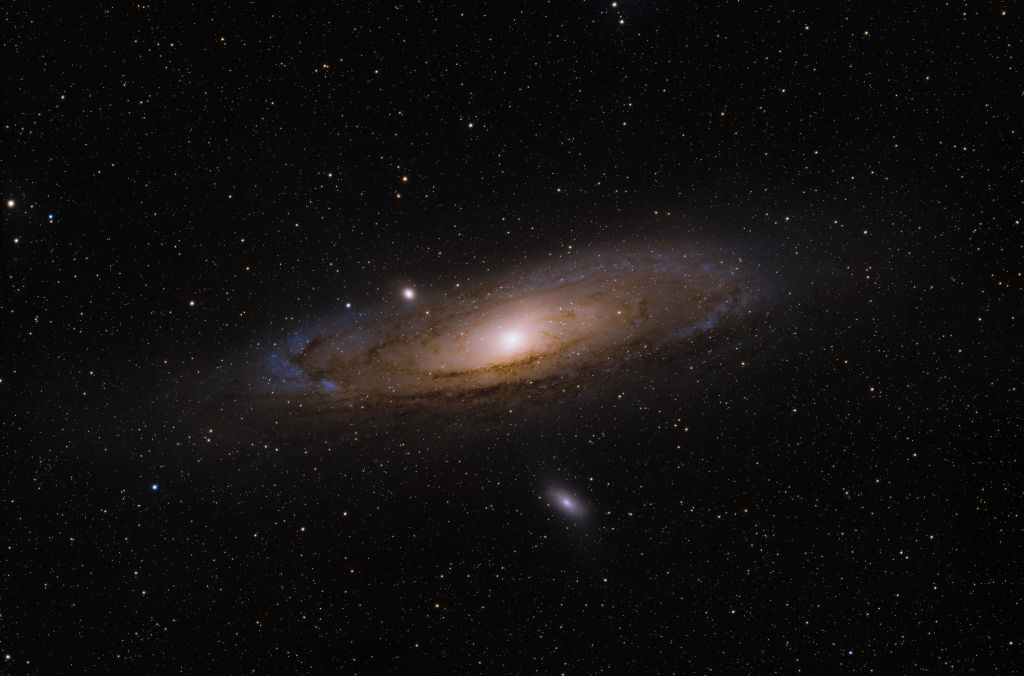
I wasn’t satisfied with this image as it was one of my earlier images. I took the image over 3 nights, and did not take separate flats for each night, and unfortunately it does cause noticeable defects in the image. I also had a different camera which would give a wider field of view, so I reshot. I processed with the same workflow, and I’m quite happy with the results.
Technical Card
Mount: Celestron AVX
Camera(s): ZWO ASI 2600mc pro, ZWO ASI 120 mini guide camera
OTA: Apertura 60mm FPL-53 doublet with flattener
Filters: None
Exposure: 105 Lights @ 120 seconds
Annotated Image
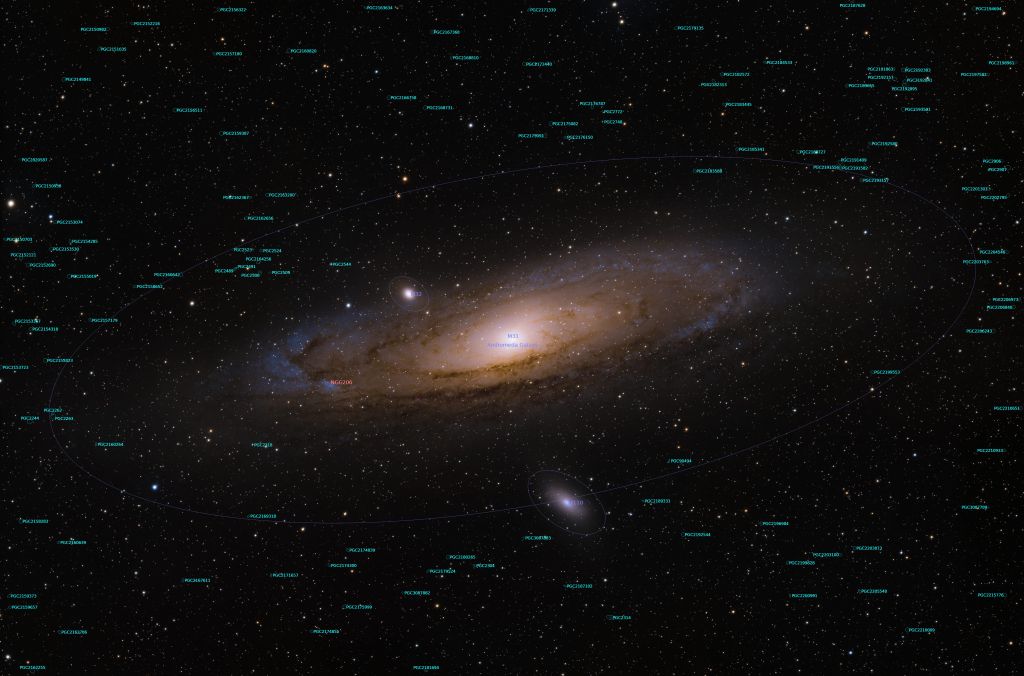
In addition to the companion galaxies M32 and M110, there are a surprisingly large number of addtional faint galaxies. Many are either not visible or cover only a few pixels.
 Sweetman Astrophotography