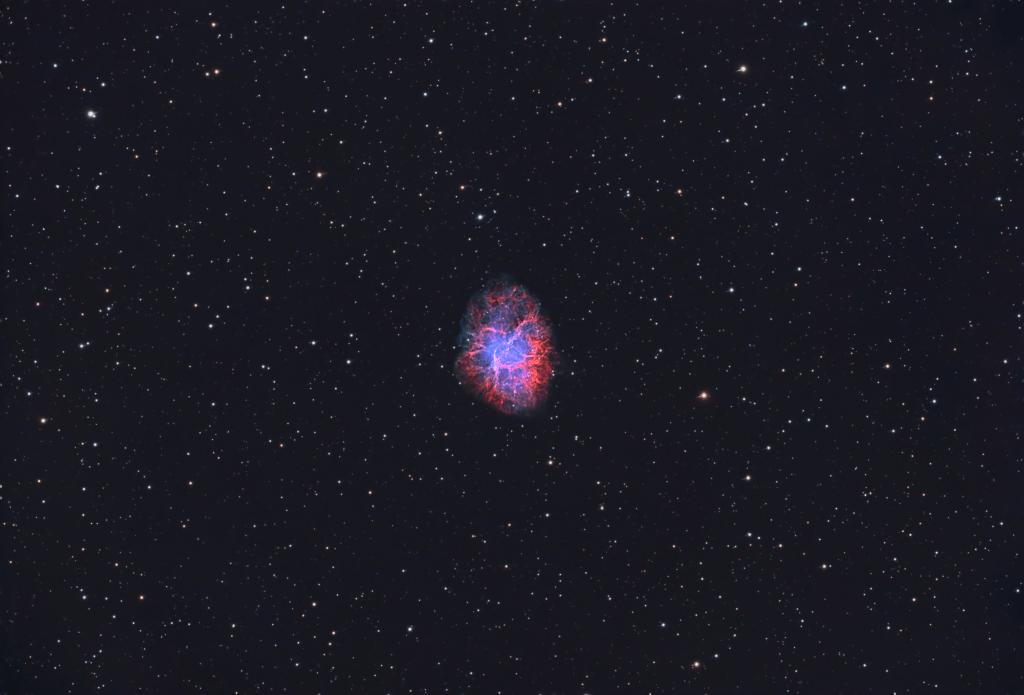
The 1st entry on Charles Messier’s eponymous list has a very interesting history. As he was observing it, hoping he had found a comet, he eventually decided it had no motion, and that it would be helpful to have a catalogue of items ruled out as comets. It gets its current name, “The Crab Nebula” from William Parsons, 3rd Earl of Rosse. Although he later changed his mind, he thought it resembled a crab, and the name stuck. It was discovered by several western astronomers independently during the late 1700 and early 1800’s.
In the early 1900’s the work of several astronomers independently detected changes in the structure, confirmed it was expanding, and realized it was located at the position of the “guest star” recorded by the Chinese and Japanese in 1054. This was sufficient evidence to conclude that this is indeed the remnants of a supernova, and make it the first supernova to be observed connected to modern day observable remnants.
Processing
Processing was with PixInsight utilizing the RC Astro plugins as well as the Narrowband Normalization tool. This is a fairly bright object, and excellent contrast with the background was achieved after a single night of exposure
Technical Card
Mount: Celestron AVX
Camera(s): ZWO ASI 294mc pro, ZWO ASI 220 mini guide camera on an OAG
OTA: Celestron C8 SCT with 6.3 reducer
Filters: Optolong L-eNhance
Exposure: 55 Lights @ 360 seconds
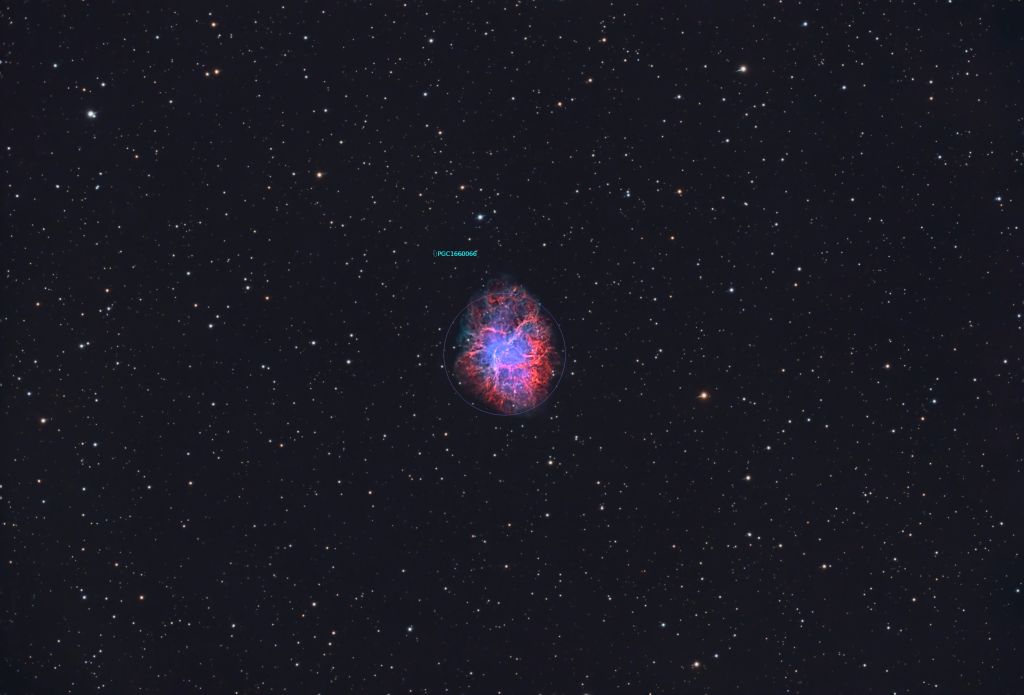
Annotated Image
Not many other objects of note in the background of this image. Just one very faint galaxy that wouldn’t be identifiable without the annotation.
 Sweetman Astrophotography