Pros
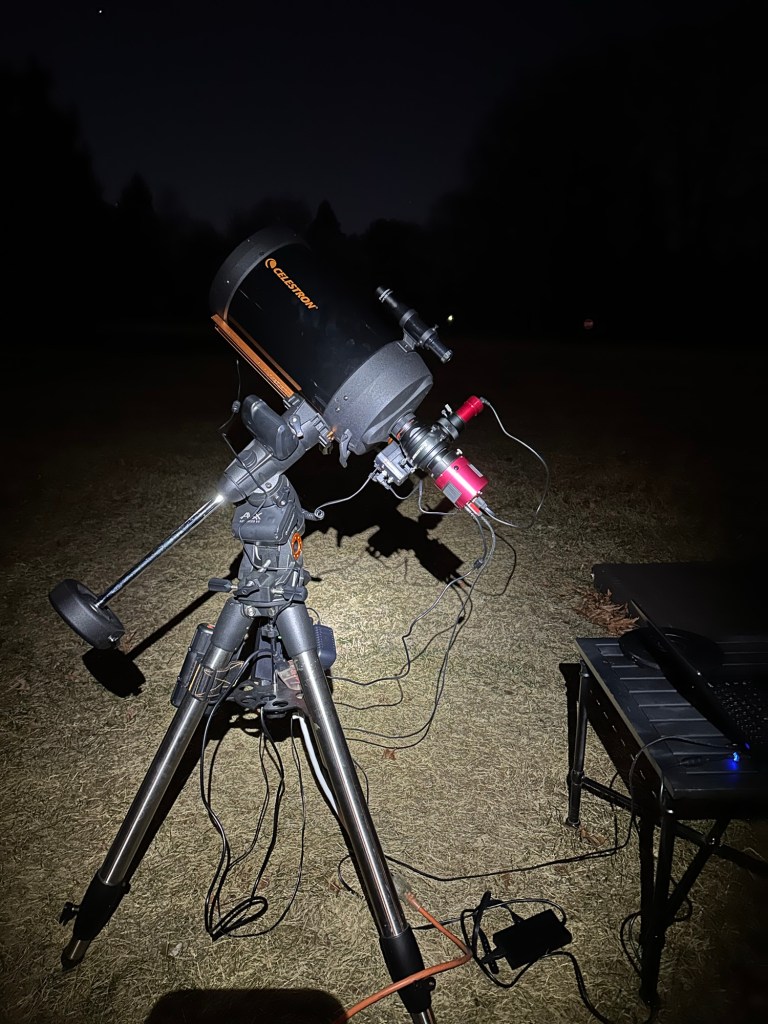
My first overall impression of the Celestron Advanced VX mount is that this is a solid piece of equipment. The tripod is easily adjustable and sturdy. The mount head is cast aluminum and feels quite substantial. There are two plastic bulges on the mount that cover the DEC and RA motors, and those feel like a weak point. But overall for a budget mount the initial impression is one of solid and durable construction.
The mount is controlled via a hand controller. This controller contains a database of over 40,000 objects for GOTO instructions, and it is the primary means of aligning the telescope or adjusting settings. The controller is also capable of pass through operation, either via connecting to a PC or Mac via serial port or microUSB on the newer versions. I find the hand controller to be quite cumbersome and impractical, and basically never use it except in pass through mode. Overall, the hand controller is not a selling point for me, but the other options available make this mount easily suitable for use at both outreach events interacting with the public and useful for photography.
For public outreach events, the combination of the Wi-Fi adapter and StarSense AutoAlign transforms the AVX into a remarkably approachable system. Controlled via an iPad, the mount becomes intuitive and engaging—especially for newcomers. The visual interface allows users to explore the sky interactively, and rapid realignment is invaluable when someone inevitably bumps the tripod. In this configuration, the AVX truly shines as an outreach mount.
Overall, this is a solid entry-level, jack-of-all-trades mount. It has a listed payload of 30lbs, and many people successfully push up to that limit for both visual and astrophotography usage.
Cons
Unfortunately, there are a substantial number of cons, and I’ll go through them in rough order of severity to me. First is portability. I still think of myself as young and strong, but this mount is heavy. I leave it assembled in my garage for astrophotography, and carry it out fully assembled with two counterweights about 50ft. I think it weighs about 60lbs. I wouldn’t go much farther than that. For further travel, the counterweights come off the shaft, the mount head comes off the tripod, and there is some assembly and teardown involved. And the pieces still weigh quite a bit, the mount head alone is 18lbs.
Although the build quality initial impression is good, aside from the plastic motor covers, I think it does leave something to be desired. I have no real quality complaints on mine, but there are reports of build issues. Furthermore, there was the formerly offered Hypertune service, and the Jason Burns teardown videos, where for less than $100 of higher quality bearings and lube the payload capacity can be boosted by 10lbs, and the tracking capability improved substantially. That’s somewhat disappointing to have design (or build process) that leaves so much easily attainable performance on the table.
That leads to my first substantial criticism of the mount. This mount, without hypertuning or rebuilding has serious backlash issues. Jason Burns has an excellent video on the topic, but basically PHD2 defaults will fail to guide this mount adequately. Without a rebuild or hypertune, guiding at 1 arcsecond RMS with substantial excursions beyond 1 arcsecond is pretty much the limit of guided tracking accuracy. This will limit photography performance at higher focal lengths.
Another substantial drawback of the Celestron system is the CPWI software. While the software has many useful features, it is unfortunately not particularly stable, and it is required for photography. The software is prone to random crashes, and erratic behavior at the meridian flip. Starfront observatories will not accept Celestron mounts due to this issue, so if you go down this route, your options for remote hosting will be limited. (This last point applies to all Celestron branded mounts.)
Overall Recommendation
This is a budget oriented mount, so my recommendation is highly price dependent. These mounts do last a long time, I’m the second owner of this one, and it’s nearly ten years old, and still working as advertised. When combined with some of the optional accessories, such as the Wi-Fi and the StarSense, this mount is downright fun for visual observation, and a capable entry level mount for astrophotography.
These mounts frequently pop up on the used market for $500-$600, and at that price, I think they are good deal. You can expect years of performance, and as long as your expectations are level set (1 arcsecond accuracy max), you won’t be disappointed. However, at the new mount list price of $1199 it’s less of a clear buy, I think there are more compelling options at higher price points. It used to be that it was only a few hundred dollars more for an entry-level strain wave mount, or a heavier duty mount of another brand. In that situation I’d have actively recommended against this mount, however, in the last few months most other mounts have increased prices, making a new AVX at least worthy of consideration.
If you are looking for a more advanced astrophotography mount or think you will in the future, I would recommend against the AVX. You will soon run into the limitations and need to either rebuild it or replace it with a more capable mount. Also, if you are considering a remote observatory, this mount will not be suitable.
 Sweetman Astrophotography